Voyager 1 Reaches the One-Light-Day Milestone
Voyager 1 and the One-Light-Day Milestone: How Far Is NASA’s Farthest Spacecraft?
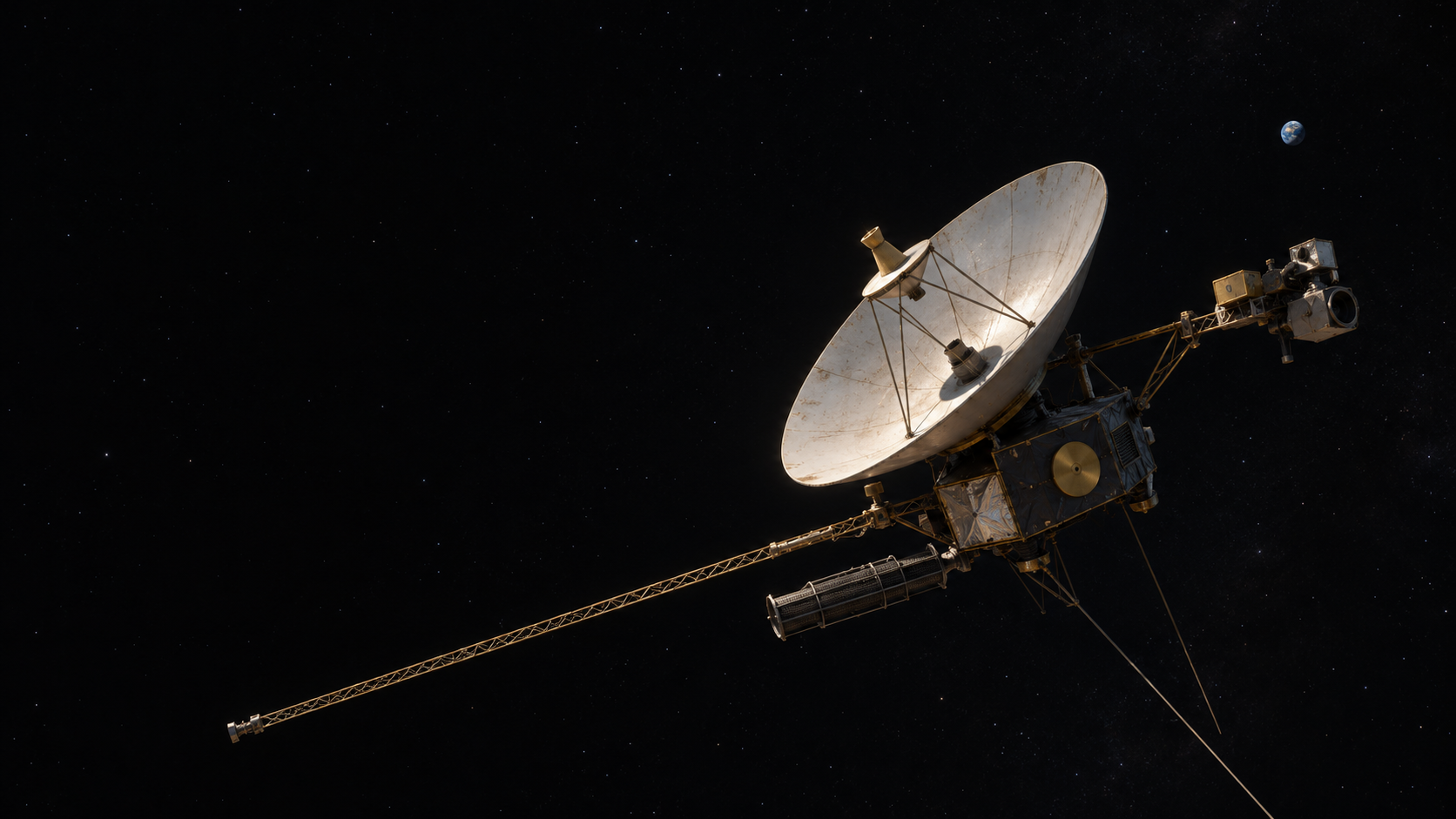
Voyager 1 is humanity’s most distant operational spacecraft. Launched in 1977, it traveled beyond the heliosphere, entered interstellar space and continued returning data across an enormous distance.
Recent reports state that Voyager 1 has reached, or is approaching, approximately one light-day from Earth. One report gives a distance of 16,094,799,096 miles, or about 25.9 billion kilometers, and identifies November 18 at 5:16 a.m. EST as the milestone time Source 3. Other coverage describes Voyager 1 as approaching the distance rather than definitively crossing it Source 5. NASA’s official mission data remains the definitive reference for the exact distance and crossing date.
The central fact is clear: Voyager 1 is farther from Earth than any other human-made object. Its distance is now so great that radio signals require approximately one day to make the journey one way.
What Is a Light-Day?
A light-day is the distance light travels through space in 24 hours. Because light travels at approximately 299,792 kilometers per second, one light-day equals roughly:
- 16.1 billion miles
- 25.9 billion kilometers
- 173 astronomical units
An astronomical unit, or AU, is the average distance between Earth and the Sun.
A light-day measures distance, not the spacecraft’s speed or travel time. Voyager 1 did not travel at the speed of light or take one day to reach its current position. It accumulated this distance over nearly five decades while moving at roughly 17 kilometers per second relative to the Sun.
The term also describes communication delay. If Voyager 1 is one light-day away, a radio command sent from Earth takes approximately 24 hours to arrive. A reply takes another 24 hours, making a complete exchange about two days, excluding processing and scheduling time.
How Far Away Is Voyager 1?
Reports place Voyager 1 at approximately 16.1 billion miles, or 25.9 billion kilometers, from Earth. That distance corresponds closely to one light-day Source 3.
The exact figure changes continuously because Voyager 1 is still moving outward. Calculations may also differ according to the measurement time, whether the reference point is Earth or the Sun, the coordinate system and rounding conventions. For that reason, “approximately one light-day” is often more useful than an excessively precise figure.
At this distance, sunlight and radio signals need about 24 hours to travel between Earth and Voyager 1. The delay results from the distance across space, not from a slow communications system aboard the spacecraft.
When Did Voyager 1 Reach One Light-Day?
Some reports state that Voyager 1 crossed the one-light-day distance on November 18 at 5:16 a.m. Eastern Standard Time, after approximately 49 years in space Source 3.
Other coverage describes Voyager 1 as nearing one light-day Source 5.
The difference may reflect publication timing, rounding or different distance references. The safest conclusion is that Voyager 1 has reached or is reaching approximately one light-day from Earth, pending confirmation of the exact milestone in NASA’s official mission data.
Voyager 1’s Journey
NASA launched Voyager 1 on September 5, 1977. Its original mission focused on Jupiter and Saturn, where it studied atmospheres, magnetic fields, rings and moons.
Voyager 1 observed Jupiter’s atmosphere and volcanic activity on Io. At Saturn, it examined the planet’s rings and atmosphere and made close observations of Titan.
The spacecraft used gravity assists to change its speed and direction. By passing near moving planets, Voyager 1 used their gravity and orbital motion to alter its trajectory without carrying enough fuel for conventional propulsion.
Voyager 1 crossed the heliopause in 2012, according to NASA mission history Source 1. The heliopause is the outer boundary of the heliosphere, the vast bubble created by the solar wind.
Crossing the heliopause means Voyager 1 entered interstellar space. It does not mean the spacecraft has left the Sun’s gravitational influence. The solar system extends much farther in the gravitational sense than it does as a region controlled by the solar wind.
- Heliosphere: The region dominated by the solar wind.
- Interstellar space: The environment beyond the heliopause.
- Solar system in the gravitational sense: A much larger region influenced by the Sun’s gravity.
How Voyager 1 Communicates With Earth
Voyager 1 communicates through radio waves. At a distance of one light-day, a command takes roughly 24 hours to reach the spacecraft. Engineers must transmit the command, wait for it to arrive, allow the spacecraft to execute it and then wait for the response.
A two-way exchange can take about 48 hours or longer. This delay complicates troubleshooting because engineers cannot control Voyager 1 in real time. They must design cautious commands and wait for telemetry to confirm the result.
NASA uses the Deep Space Network, a system of large radio antennas positioned around Earth. It sends commands, receives scientific data, tracks spacecraft position, measures radio signals for navigation and monitors spacecraft health.
Radio signals weaken as they spread through space. Voyager 1’s available electrical power also declines, limiting transmitter capability and reducing the number of instruments that can remain active.
What Voyager 1 Measures in Interstellar Space
Voyager 1’s remaining instruments study the environment beyond the heliosphere. Its measurements include:
- Plasma waves
- Magnetic fields
- Charged particles
- Cosmic rays
These observations help scientists study the boundary between the heliosphere and interstellar space. Earth-based telescopes cannot replace a spacecraft directly sampling the local interstellar environment.
The Golden Record
Voyager 1 carries the Golden Record, a phonograph record containing sounds, images and greetings intended to represent life and culture on Earth. NASA placed a similar record aboard Voyager 2.
The record is a cultural time capsule, not an operational system. It does not control the spacecraft, transmit messages to Earth or support scientific instruments. Even after communication ends, Voyager 1 and its record will continue moving through space.
Why Voyager 1 Still Matters
Voyager 1 has survived decades of vacuum, radiation, extreme cold and declining electrical power. Its longevity reflects conservative engineering, redundant systems, durable hardware, careful power management and the work of generations of engineers.
NASA has gradually shut down instruments, heaters and other systems to conserve energy. The spacecraft’s remaining measurements continue to provide information about the heliosphere and the space between stars.
Voyager 1 also represents a cultural achievement. It is the farthest human-made object from Earth and an example of technology continuing far beyond its original purpose. The one-light-day milestone gives that achievement a human scale: a message from Earth requires an entire day of light travel to arrive.
What Happens Next?
Voyager 1 will continue moving outward after its scientific mission ends. Its radioisotope thermoelectric generator produces less electricity over time, so NASA must keep reducing the spacecraft’s energy use. The likely sequence includes:
- Turning off scientific instruments
- Disabling additional heaters
- Reducing support functions
- Losing communication capability
- Ending useful scientific transmission
The end of communication will not stop Voyager 1’s motion. At its current speed, the spacecraft would need many thousands of years to travel one light-year. It is not heading toward a nearby exoplanet or habitable world; interstellar space is mostly empty, and the distance between star systems is enormous.
Common Misunderstandings
Voyager 1 Did Not Travel at the Speed of Light
A light-day is a distance unit. Voyager 1 travels far slower than light and accumulated its distance over nearly five decades.
Voyager 1 Has Not Traveled One Light-Year
One light-year is approximately 365 times farther than one light-day. Voyager 1 remains close to the solar system by galactic standards, despite being far beyond the planetary region.
Interstellar Space Does Not Mean Another Star System
Voyager 1 is in the space between stars. It has not reached another star system or approached a known habitable planet.
“Outside the Solar System” Has Multiple Meanings
Voyager 1 is outside the heliosphere but remains within the Sun’s broad gravitational influence. The meaning depends on whether the boundary is defined by the solar wind or gravity.
Conclusion
Voyager 1 has reached or is approaching approximately one light-day from Earth, according to recent reports. The milestone represents a distance of about 16.1 billion miles, or 25.9 billion kilometers, and creates a one-way radio delay of roughly 24 hours.
Launched in 1977, Voyager 1 completed its planetary mission, crossed the heliopause in 2012 and continues to measure conditions in interstellar space. Its shrinking power supply will eventually end communication, but the spacecraft will keep traveling outward.
The milestone does not mean humanity has crossed a light-year or reached another star. It marks the point at which human technology has extended far enough that even a radio message needs an entire day to arrive.
Frequently Asked Questions
How far away is Voyager 1 from Earth?
Voyager 1 is approximately 16.1 billion miles, or 25.9 billion kilometers, from Earth based on reported one-light-day figures. The exact distance changes continuously.
What is one light-day?
A light-day is the distance light travels in 24 hours. It equals approximately 16.1 billion miles or 25.9 billion kilometers.
How long does a signal take to reach Voyager 1?
At a distance of one light-day, a radio signal takes approximately 24 hours to travel from Earth to Voyager 1. A command-and-response exchange can take about two days or longer.
Is Voyager 1 outside the solar system?
Voyager 1 is in interstellar space because it crossed the heliopause in 2012. However, it remains within the Sun’s broader gravitational influence, so the answer depends on the definition of “solar system.”
When did Voyager 1 launch?
Voyager 1 launched in 1977. Its original mission focused on Jupiter and Saturn before NASA extended it into the outer solar system and interstellar space.
Will Voyager 1 keep working forever?
No. Its radioisotope power system produces less electricity over time. NASA has shut down systems to preserve power, and the spacecraft will eventually stop transmitting useful data. It will continue traveling after communication ends.
Related Articles
-
 Voyager Probe Nears One Light-Day From Earth
-
 Thinkers of Cernavodă: Stone Age Figurines
-
 Why NASA Wants You to Shine a Light for Voyager 1
-
 Stephen Hawking’s Private Life Reexamined
-
 Ebola Is Survivable: Why Prompt Treatment Matters
-
 Leonid Meteor Shower Peaks Tonight: Viewing Guide
-
 Hayabusa2 and 1998 KY26: What the Target Change Means
-
 Starship Flight 15, Tesla Merger, and $74B AI Bet
-
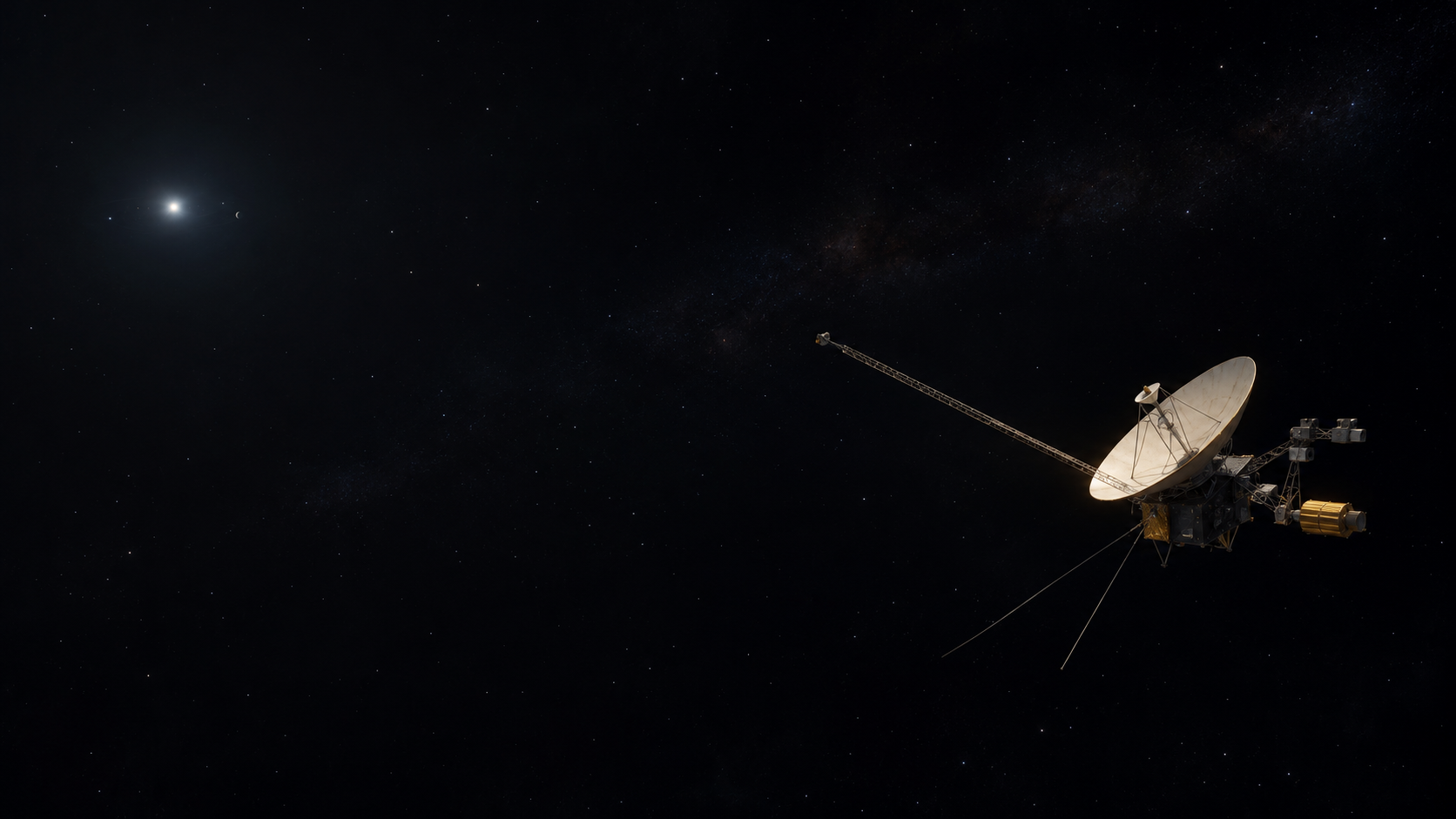 Voyager 1 Approaches One Light-Day From Earth
-
 Leonid Meteor Shower 2026: Peak Dates and Viewing Guide
-
 ʻOumuamua: The Mysterious Interstellar Visitor
-
 Curiosity Finds Bright Yellow Elemental Sulfur on Mars
-
 Victor Glover’s Toughest Artemis II Challenge Explained
-
 What Makes Up the Cosmos? Evidence of Missing Physics
-
 Northern Lights Alert: 12 States May See Aurora
-
 Metal Potatoes May Host Dark-Oxygen Ecosystems