Ukraine’s Reported Strike on the Kerch Bridge
Ukraine’s Reported Strike on the Kerch Bridge
Editorial note: The reports supplied for this article are dated November 2026, a future date relative to the current publication context. The incident date, weapon attribution, casualty figures, structural damage, and operational status require verification before publication. This article distinguishes reported claims from independently established facts.
Introduction: A Strike Against a Bridge and a Symbol
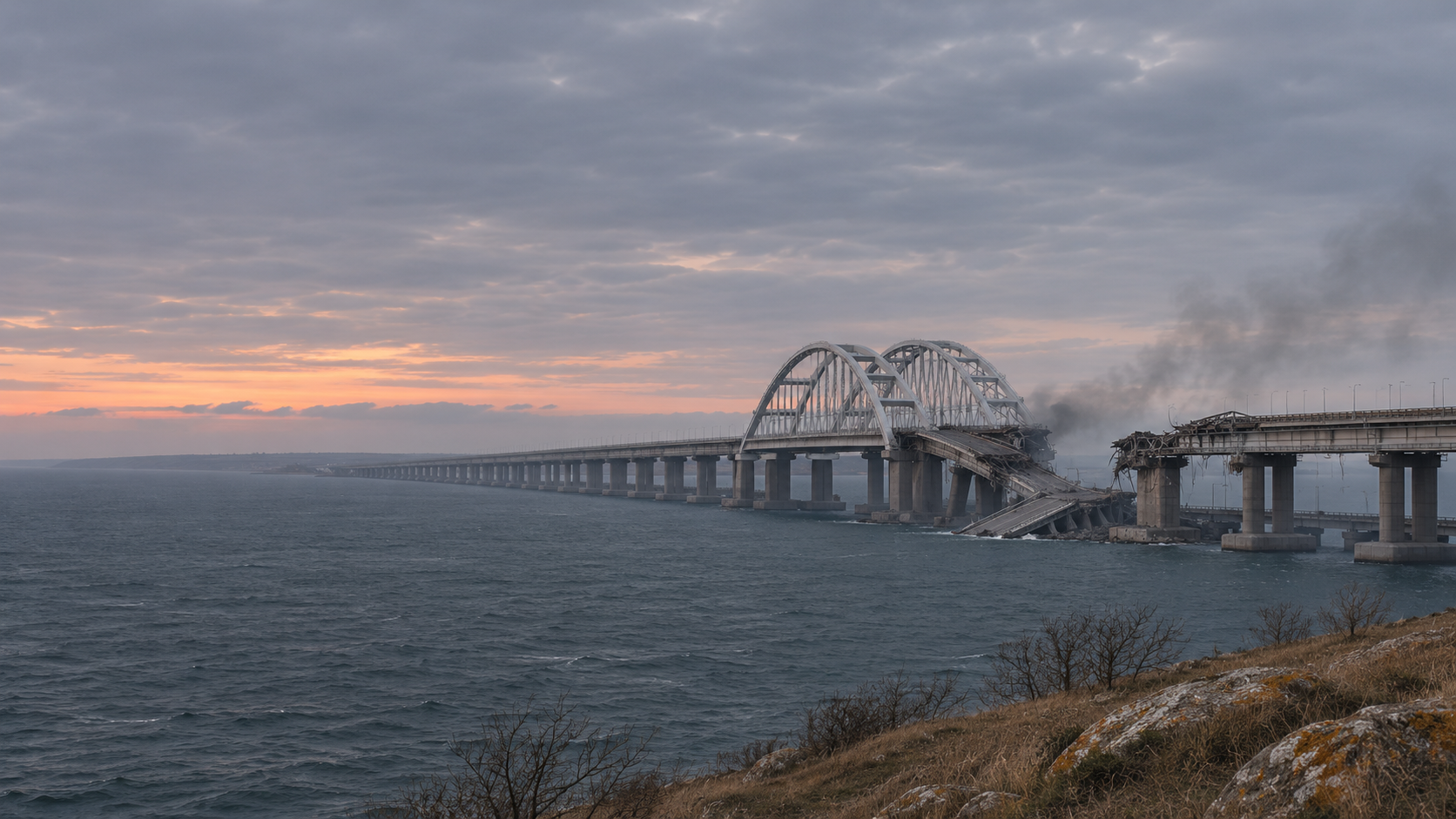
Reports describe a Ukrainian strike that destroyed or severely damaged a span of the Kerch Bridge, the road-and-rail connection across the Kerch Strait between Russia and occupied Crimea.
The bridge carries civilian traffic and commercial goods. It may also support the movement of fuel, equipment, personnel, and military supplies. Since Russia’s 2014 annexation of Crimea, which Ukraine and most of the international community reject, the bridge has represented Moscow’s effort to present the peninsula as permanently integrated into the Russian state.
PBS reported that Ukraine destroyed a span of the bridge, while The New York Times cited verified video showing a strike on the structure. The National Interest described it as severely damaged. These reports indicate a major reported incident, but they do not establish the full extent of the damage, the bridge’s operational status, or the weapons used.
The central questions are how much transport capacity was lost, how quickly Russia can restore it, and what the strike communicates about Crimea’s contested status.
What Happened?
Reports Describe a Destroyed or Severely Damaged Span
The supplied reports use different descriptions. PBS reported the destruction of a span. The New York Times reported that Ukraine struck the bridge, citing verified video. The National Interest described severe damage. SOFX Report said a Ukrainian strike destroyed a span and blocked the shipping channel leading to the Sea of Azov.
These terms are not interchangeable. A destroyed span suggests the loss of a major structural section. Severe damage may mean that the bridge remains standing but cannot safely carry normal traffic. Disabled could describe a temporary closure caused by inspections, security measures, or limited structural damage.
The final assessment requires engineering inspections and official traffic information. Authorities must determine whether the road deck, rail line, or both were affected; whether adjacent spans remain stable; and whether restricted traffic can resume.
What Visual Evidence Shows
Verified video can help establish an attack’s location and approximate timing. It can be compared with satellite imagery, bridge features, weather conditions, and geographic information.
Video does not necessarily prove the weapon used, the number of projectiles launched, the identity of the attacking unit, or the total military effect. It may also fail to show underwater damage or weaknesses affecting nearby spans.
Unverified social media footage requires caution. Images may be old, miscaptioned, edited, or recorded elsewhere. Wartime actors may release selective footage to support competing narratives.
Questions Requiring Confirmation
- Which span or spans were affected?
- Was the road deck, rail line, or both damaged?
- Did traffic stop completely?
- Were maritime movements through the strait suspended?
- How long could repairs take?
- Can Russia use ferries, land routes, or other links during repairs?
The answers will determine whether the incident is primarily symbolic, temporarily disruptive, or a sustained logistical setback.
Why the Kerch Bridge Matters
Russia’s Main Physical Link to Crimea
The Kerch Bridge crosses the Kerch Strait and connects mainland Russia with Crimea. Its road and rail infrastructure makes it one of the most visible physical links between the peninsula and Russia.
For civilians, it supports passenger travel and commercial distribution. For Russian authorities, it also facilitates administration, construction, security operations, and resource movements. Ukraine rejects Russia’s sovereignty claim over Crimea, giving the bridge a dual character: it is transport infrastructure and part of the occupation’s administrative and military architecture.
A Critical Logistics Route
A functioning bridge can carry fuel, ammunition, vehicles, personnel, construction materials, and repair equipment. Its road-and-rail design gives Russia flexibility in moving different types of cargo.
The supplied sources do not establish what share of Russian military supplies crosses the bridge. Russia also has alternative routes into occupied southern Ukraine and Crimea, so the bridge should not be described as the only possible supply line.
Disruption can still impose costs. Alternative routes may be longer, slower, more expensive, and more exposed to attack. Russia may need to reroute cargo, prioritize military shipments, delay civilian traffic, or rely on maritime and ferry services.
The Bridge and Sea Access
The Kerch Strait connects the Black Sea with the Sea of Azov. Damage to bridge infrastructure could affect vessel movements if debris, structural instability, or safety restrictions obstruct navigation.
SOFX Report said the strike blocked the shipping channel to the Sea of Azov. That claim requires confirmation from maritime authorities, navigation notices, satellite-based ship tracking, or independent observers. Disrupted shipping could also result from inspections, security operations, or emergency repairs rather than a physical obstruction.
Why Ukraine Has Targeted the Bridge
Disrupting Logistics and Defenses
The New York Times described destruction of the bridge as a major objective for Kyiv. Ukraine’s likely aims include disrupting Russian logistics, forcing the diversion of defensive resources, and demonstrating that a heavily protected target remains vulnerable.
A successful strike could also force Russia to deploy additional air defenses, surveillance systems, patrols, and repair teams around the bridge. The attack alone does not prove that Crimea has been cut off. Russia may retain several resupply routes, and repairs could restore capacity.
The Bridge as an Instrument of Occupation
The bridge physically connects Crimea to Russia and reinforces Moscow’s message that the peninsula is an established part of the Russian state. Damaging it challenges that message and gives Ukraine evidence that the occupation’s infrastructure remains vulnerable.
The strike therefore carries two messages. Operationally, it threatens transport. Politically, it contests Russia’s claim that the occupation is irreversible.
Reported Use of European-Made Ruta Missiles
Reuters reported that a company said European-made Ruta missiles were the only foreign weapons used by Ukraine in the strike. This is a company claim, not independent confirmation.
Open questions include:
- Were Ruta missiles used?
- How many were launched?
- Did Ukrainian-made weapons participate?
- Does “only foreign weapons” describe the entire operation or one stage?
- Did the company have direct access to operational information?
No technical specifications should be added without reliable primary documentation. A company statement does not establish the legal status of a transfer, the identity of a supplier, or whether a European government authorized the operation.
If independently confirmed, the use of a European-made system could intensify debate over defense exports, targeting policy, and long-range weapons. The supplied reporting does not establish those political or legal details.
Military Consequences for Russia
A damaged span could suspend road or rail traffic, trigger inspections, and delay supplies between Russia and Crimea. The effect will depend on parallel infrastructure and alternative routes.
Russia could shift traffic to land corridors through occupied southern Ukraine, ferries, maritime transport, or other regional connections. Longer routes consume more fuel and time, while lower-capacity routes create bottlenecks. Additional checkpoints, depots, and transfers also increase uncertainty and vulnerability.
Russia may tighten security, expand air-defense coverage, increase surveillance, restrict civilian movement, and accelerate repairs. Official accusations or threats of retaliation should be separated from confirmed actions.
Consequences for Crimea and Civilians
Bridge closures could affect passenger travel, food distribution, fuel deliveries, medical supplies, and commercial transport. These effects should not be described as shortages without local confirmation.
Authorities may use traffic rationing, ferry services, alternative roads, or priority access for emergency and military traffic. Such measures can reduce disruption while imposing delays and higher costs on residents.
Safety risks could affect travelers, bridge workers, maritime traffic, and communities facing heightened security restrictions. Casualty figures should be included only when confirmed by multiple credible sources. The supplied reports do not provide a confirmed casualty total.
Symbolism and Strategic Messaging
The bridge was designed to make Crimea’s connection to Russia appear permanent. A major strike exposes the limits of that permanence.
For Ukraine’s domestic audience, the operation may reinforce claims of resistance and demonstrate an ability to reach high-value targets. Public reaction should not be presumed to be uniform; the event may generate pride, anxiety, concern about escalation, or uncertainty about civilian consequences.
For international partners, the strike may signal that advanced capabilities can affect major Russian assets. It could support Ukraine’s argument that long-range weapons are central to its defense. The supplied sources do not establish whether any foreign government authorized the operation. Weapon supply and operational authorization are separate questions.
What the Strike Does Not Prove
Damage to the Kerch Bridge does not by itself prove that:
- Crimea has been isolated.
- Russia cannot resupply its forces.
- The bridge cannot be repaired.
- The war has entered a decisive phase.
- Ruta missiles were used.
- Foreign governments authorized the operation.
- The entire bridge lost both road and rail capacity.
Military infrastructure can be restored, and alternative routes can reduce the effect of a closure. Symbolic and operational effects may be significant at the same time, but they are not identical.
What to Watch Next
The most important indicators are official closure notices, engineering inspections, repair schedules, road and rail reopening, and maritime navigation restrictions.
Observers should also monitor alternative transport routes, Russian supply patterns, new defensive deployments, and further attacks on transport infrastructure. These developments may show whether the strike caused a temporary inconvenience or a sustained logistical problem.
Russian accusations, Ukrainian statements, European government responses, and debates over long-range weapons could shape the incident’s wider consequences even if physical repairs proceed quickly.
Conclusion
The reported Ukrainian strike against the Kerch Bridge has two dimensions. It may disrupt a major transport link between Russia and Crimea, and it damages one of the most visible symbols of Russian control over the peninsula.
Multiple supplied reports describe a strike and major bridge damage. PBS reported the destruction of a span; The New York Times cited verified video; and The National Interest described severe damage. SOFX Report said the shipping channel to the Sea of Azov was blocked, but that consequence requires independent confirmation. The Ruta missile attribution comes from a company statement reported by Reuters and remains unverified.
The decisive questions are the bridge’s structural condition, the duration of road and rail closures, the status of maritime traffic, and Russia’s ability to reroute supplies. Whatever the final engineering assessment, the incident shows that the Kerch Bridge remains both a strategic logistics asset and a political symbol. Its vulnerability demonstrates that control of Crimea is contested, not settled.
Frequently Asked Questions
What is the Kerch Bridge?
The Kerch Bridge is a road-and-rail connection across the Kerch Strait linking mainland Russia with Crimea, which Russia occupies and claims to have annexed.
Why is the Kerch Bridge important to Russia?
It supports civilian travel, commercial transport, administration, and logistics between Russia and Crimea. It can also carry military personnel, vehicles, fuel, equipment, and supplies.
Did Ukraine completely destroy the Kerch Bridge?
The supplied reports describe a destroyed span or severe damage. They do not establish that the entire bridge was destroyed or that all road and rail capacity was lost.
What weapons were reportedly used?
A company cited in a Reuters report claimed that European-made Ruta missiles were the only foreign weapons used. That claim requires independent verification.
Did the attack block shipping to the Sea of Azov?
SOFX Report said the strike blocked the shipping channel. This remains a reported consequence pending confirmation from maritime authorities or independent monitoring.
What could happen next?
Russia may impose restrictions, increase security, reroute traffic, and begin repairs. Ukraine may continue targeting infrastructure connected to the occupation. The effect will depend on the damage, repair timeline, and available alternative routes.
Related Articles
-
 Reported Iran Attacks on Kuwait and Bahrain Escalate Gulf Crisis
-
 APEC Summit: Xi-Putin Talks and Trump-Kim Signals
-
 American Soldier in UK Taken Into US Military Custody
-
 Mary Peltola Did Not Defeat Dan Sullivan
-
 Rubio: No Evidence Linking U.S. Outages to Malign Actor
-
 Kelly Challenges Hun Cao’s Navy-Ship Food Analogy
-
 White House Withdraws Heidi Overton FDA Nomination
-
 Iran’s Reported Bahrain Strike Prompts U.S. Retaliation
-
 Why Europe Fears a Trump-Xi-Putin Summit
-
 How Ukraine Struck the Kerch Bridge—and Why It Matters
-
 Canada-China Trade Pact: What Carney and Xi Announced
-
 Hung Cao Faces Tough Questions at Navy Hearing
-
 Prosecutors: Man Destroyed $60M U.S. Military Plane
-
 Trump Says Reported Iran Bomb Plot Is Taken Seriously
-
 Sea Turtle Hatchlings Emerge from California Beach Nest
-
 Trump’s Late Arrival Looms Over Southeast Asia Summit